What if a Celebrant wedding could also be legal?
Read about how the current consultation by the government on wedding law reform could transform the world of independent celebrant weddings.
Dawn Vincent
4/6/20264 min read
Wedding law reform is on the table in England and Wales and it matters more than you might think. Something significant is happening at Westminster right now, and if you're planning a wedding, or even just thinking about it, this is worth knowing about.
The government is currently consulting on changes to wedding law in England and Wales. On the table is the possibility of allowing independent celebrants to legally marry couples. And honestly? It's long overdue.
But before we get into why this matters so much, let me paint you a picture of how things work right now.
The two-ceremony problem
For many couples in England and Wales, getting married currently means doing it twice. There's the legal part, a formal appointment at a register office, bound by rules about what can and can't be said or included. And then there's the real ceremony. The one that tells your story. The one that includes your people, your values, your slightly-chaotic dog, your best friend's terrible-but-brilliant joke. The one that actually feels like you.
Two events. Two sets of nerves. Two lots of planning.
Scotland doesn't do it this way. Up there, Humanist celebrant-led weddings are already legally recognised. Couples choose one ceremony, their ceremony, and it counts for everything. So they’ve modernised the wedding law slightly but still haven’t included independent celebrants. England and Wales currently have the opportunity to totally modernise wedding law and ensure that all couples regardless of culture, religion and heritage can have a legal ceremony that works for them. This consultation is the moment where that possibility is genuinely being considered.
So what's actually being proposed?
The reform being discussed would modernise how weddings are legally conducted, including changing who has the authority to officiate. There's growing support for Humanist ceremonies to receive legal recognition, and that's a positive step. But here's where it gets important, and where I'd encourage you to pay attention. Independent celebrants, who deliver thousands of weddings across the UK every year, also need to be included in any new framework.
Humanist celebrants vs independent celebrants, what's the difference?
The terms sometimes get used interchangeably, but they're not the same thing. Humanist celebrants work within a specific non-religious belief system: Humanism. Their ceremonies are thoughtful and meaningful, but they operate within a defined framework. Religious or spiritual elements cannot be included.
Independent celebrants, like me, aren't tied to any one belief system or organisation. That means a ceremony I create can include a Humanist approach, or a spiritual element, or a cultural tradition, or a mix of all three. Whatever reflects you. Whatever actually fits your life, your relationship, your family.
If wedding law reform recognises Humanist ceremonies but leaves independent celebrants out, we haven't really expanded choice at all. We've just replaced one limitation with a different one. Couples who don't sit neatly in the "religious" or "strictly non-religious" box, which, in my experience, is a lot of couples, would still be left without a legally recognised option that genuinely reflects them.
Yes, Independent celebrants are trained professionals. Many hold formal qualifications in celebrancy. A significant number are former registrars who understand both the legal framework and the emotional weight of what a wedding ceremony means. We carry professional indemnity and public liability insurance. We invest in ongoing training and development, because this matters, and doing it well matters.
The ceremonies we create are not casual or off-the-cuff. They are carefully, thoughtfully written, often over weeks and months of working closely with a couple, to create something that genuinely reflects who they are. The word independent means freedom and flexibility. It doesn't mean informal or unserious.
I recently wrote to my MP about this, because I feel strongly that the concerns raised in Parliament about "commercialisation" of marriage don't accurately reflect what independent celebrants actually do. Churches charge fees. Humanist celebrants charge fees. Registrars work within a funded public service. Charging for professional time and expertise is not an indicator of diminished integrity, it's just how professional services work.
Are independent celebrants trained professionals?
What this reform could mean for couples
Right now, the legal framework for marriage in England and Wales is built around a binary. Religious or civil. That's it.
Wedding law reform is supposed to modernise that, to reflect how people actually live and love and form families today. Many couples want something in between. Something that honours a loose spirituality without being a church service. Something that weaves in cultural traditions from two different backgrounds. Something that includes a reading that means everything to them, even if it's from a Terry Pratchett novel rather than a scripture.
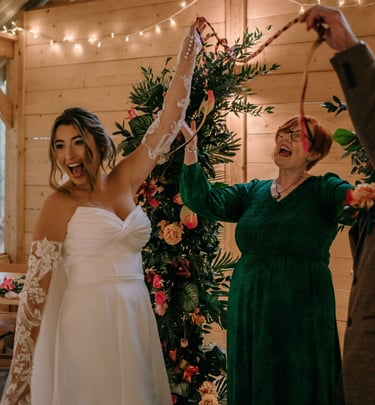
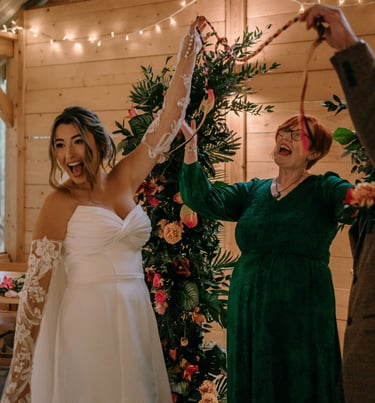
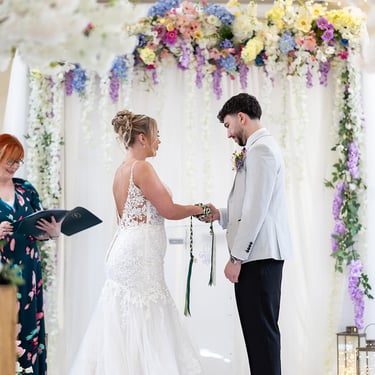
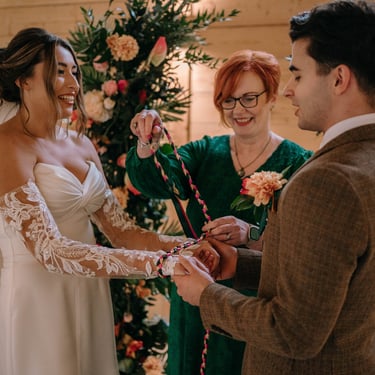
That's what celebrant-led ceremonies already offer, we just can't currently sign the paperwork at the end.
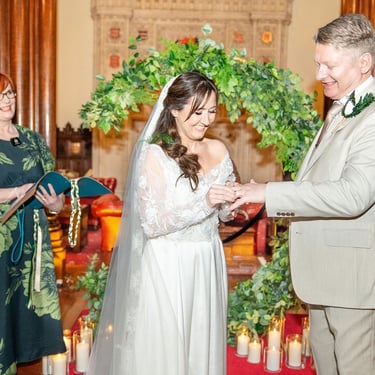
Imagine one ceremony. One moment where the legal and the personal come together in a space that feels like you, with words that actually sound like you, surrounded by the people who matter most. That's what this reform could make possible.
What you can do
The formal consultation is due to open shortly so no final decisions have been made yet. A clearer picture is expected towards the end of 2026, with any changes likely to come into force from 2027 onwards.
If you're planning a wedding, or you simply think that couples deserve real choice about one of the most meaningful days of their lives, please write to your MP. Tell them you want reform that genuinely expands options, not one that simply swaps one set of restrictions for another. You can also sign up to the Give Couples Choice movement and be kept up to date with developments.
Because a wedding should reflect the couple at its heart. And right now, the law doesn't always allow for that.
Want to know more about celebrant-led ceremonies and what they might look like for you? Get in touch, I'd love to have a chat.
© Dawn Vincent 2025. All rights reserved.




Follow me
Serving Yorkshire & the North East
Based in North Yorkshire Dawn creates ceremonies Teesside, Yorkshire, Northumberland, and the wider North East including Middlesbrough, Newcastle, Sunderland, Darlington, Durham, York, Harrogate, Alnwick, Ripon, Thirsk, Richmond, Northallerton, Scarborough, Whitby, and beyond.